
Roof Replacement in Hudson County, NJ
Shingle roof replacement with Owens Corning Duration and flat roof replacement with Firestone torch-down — full tear-off to the deck, new flashing and edge metal, permits filed with your town, and a written line-item price before a single shingle comes off. Family-owned since 2003, based in Union City, serving Jersey City, Hoboken, North Bergen, West New York, Weehawken, Bayonne, and Harrison. The owner inspects every roof we quote.
Six Signs It’s Time to Replace, Not Patch
Not every leak means a new roof — we repair far more roofs than we replace. But some roofs have reached the point where every repair is money spent on a roof that’s already gone. These are the signs we look for on the inspection.
Age
Asphalt shingle roofs in our climate generally give 20–25 years and torch-down membranes 15–20. Past that, repairs buy months, not years — and a good contractor will tell you so.
Leaks in More Than One Place
One leak is a flashing or seam problem. Leaks showing up in different rooms, or coming back after repairs, mean the membrane or shingles have failed as a system.
Widespread Membrane Failure
Blisters, alligatoring, open seams and bare spots across the field of a flat roof — not one bad detail, but the whole surface at the end of its life.
Curled, Cracked or Missing Shingles
Whole slopes of curling or cracked shingles, and gutters full of granules, mean the shingles have lost their weather layer. A few missing tabs is a repair; whole slopes is a replacement.
Spongy Deck or Saturated Insulation
Soft spots underfoot mean water is already inside the roof assembly. A new membrane over wet insulation or rotted decking fails early — tear-off is the only honest fix.
The New Jersey 25% Rule
NJ’s reroofing code sets a threshold where repairs covering more than 25% of the roof trigger a full-replacement obligation. We tell you which side of the line you’re on.
Read about the 25% rule →Shingle and Flat Roof Replacement, Done by the Same Crew
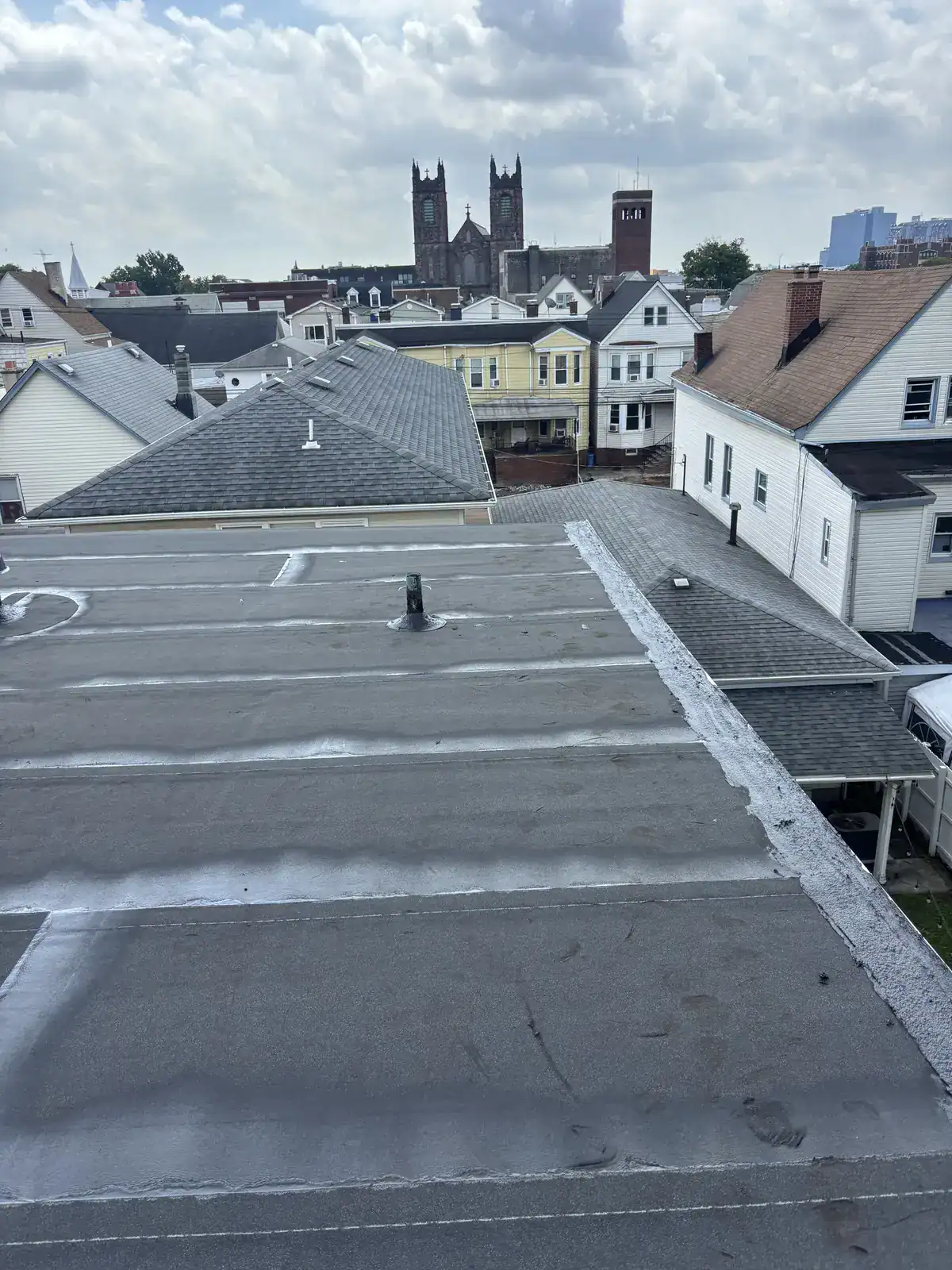
Shingle roofs: full tear-off to the deck, rotted sheathing replaced, ice-and-water shield at eaves and valleys, synthetic underlayment, new drip edge and step flashing, ridge ventilation, and Owens Corning TruDefinition Duration architectural shingles with the manufacturer’s limited lifetime warranty. Flat roofs: old layers off, Firestone SBS-modified bitumen torch-down heat-welded over a proper base, parapets re-flashed, new coping and edge metal, drains and scuppers rebuilt. And when a roof is sound but tired, we’ll say so and offer a silicone restoration instead of a replacement you don’t need yet.
What Drives Roof Replacement Cost in Hudson County
We don’t quote roofs over the phone — a number without an inspection is a guess. But the price isn’t a mystery either. These six things move it, and they’re exactly what you should see itemized on any contractor’s estimate, including ours. The FAQ below covers how a new roof is priced in New Jersey in more detail.
Roof Size & Layers to Remove
Square footage sets the baseline, and how many old layers have to come off sets the labor. Hudson County row homes often carry two or three — every layer is tear-off time and disposal weight.
Roof Type & Material Line
Architectural vs. 3-tab shingles; torch-down replacement vs. a silicone restoration. The material line you choose moves the number more than anything else, and we show you the options side by side.
Complexity & Details
Dormers, skylights, chimneys, parapet walls, HVAC curbs, roof-deck posts — every one is a flashing detail done by hand. A simple rectangle costs less than the same square footage with six penetrations.
Decking Condition
Rotted plywood or plank sheathing is replaced and itemized separately. We can’t see it until tear-off, so we price it per sheet up front — no mid-job surprises.
Access & Staging
Attached row homes with no driveway, third-floor walk-ups, tight Hoboken streets — material lifts, dumpster permits, and protection for the neighbors’ property are real line items.
Permits & Disposal
Permit fees vary by town and are listed on the estimate. Tear-off, dumpster and disposal are always included — we never bill “cleanup” as an extra.
From Estimate to Final Inspection
The same four steps for a shingle house or a flat-roofed three-family — and the owner is reachable at every one.
On-Roof Inspection & Measurements
We get on the roof, measure it, photograph every detail and check the deck from the attic or top floor where we can. You see what we see.
Written Line-Item Estimate & Permit
Materials by name, labor, tear-off and disposal, decking per sheet, permit fee — listed out. Once you approve, we file the permit with your town and schedule the inspections.
Tear-Off & Installation
Old roof off, deck repaired, new system installed by our own crew — no subcontractors. Site protected and cleaned every day, magnet-swept for nails.
Final Inspection, Photos & Warranty
Town inspection passed, finish photos sent to your phone, manufacturer warranties registered in your name, and our workmanship warranty in writing.

Torch-Down Flat Roof Replacement
How to Pick a Roofing Contractor in New Jersey
Hire the wrong roofer and you pay for the same roof twice. Six things to check before you sign anything — and how we answer each one.
Verify the NJ HIC License
Every home improvement contractor in New Jersey must be registered with the Division of Consumer Affairs. Ask for the number and look it up. Ours is NJ HIC #13VH11705800.
Ask for Proof of Insurance
A certificate of liability insurance and workers’ comp, sent by the insurer. Without it, an injury on your roof can become your claim.
Read Reviews From Your Own Town
Reviews from Union City, Jersey City and Hoboken addresses tell you a contractor works on roofs like yours. We have 160+ on Google at 4.9 stars.
Insist on a Written Line-Item Estimate
A single lump sum hides what you’re buying. Materials by brand and line, tear-off, decking, flashing, permit, disposal — each on its own line.
Ask Who Pulls the Permit
A contractor who tells you to skip the permit, or to pull it yourself as a homeowner, is telling you something. We file it and meet the inspector.
Ask Who Actually Does the Work
Many roofers sell the job and sub it out. Our crew that quotes the roof is the crew on it. See what a licensed Hudson County roofing contractor should look like.
What Hudson County Says About Their New Roofs
Roof Replacement Across Hudson County
Based at 4404 Kennedy Blvd in Union City, we’re 10–20 minutes from every town we serve.
Union City & West New York
Our home turf — we’re based at 4404 Kennedy Blvd. Attached row homes along Bergenline share parapet walls, so a neighbor’s neglected roof can leak into yours. We know these party-wall details and repair them correctly.
Union City roofing →Jersey City
Heights row homes, Downtown brownstones, Journal Square multifamilies — every roof age from 5-year-old seam repairs to 40-year-old built-up roofs overdue for replacement.
Jersey City roofing →Hoboken
Brownstone flat roofs with roof decks, skylights, and HVAC penetrations — every penetration is a potential leak. Tight access and shared walls are a staging problem as much as a roofing problem; we handle both.
Hoboken roofing →North Bergen & Weehawken
Hilltop exposure along the Palisades means more wind-driven rain than most of the county. Flashing and coping failures show up here first.
North Bergen roofing →Bayonne
Row homes plus the industrial and warehouse corridor — larger membrane fields, roof drains instead of scuppers, commercial-scale repairs.
Bayonne roofing →Harrison
Rowhome and multi-family flat roofs 15 minutes from our shop — the same torch-down details we install and repair across the county.
Harrison roofing →Hudson County’s
Roof Replacement Specialist
Gaby Roofing is a family-owned, second-generation roofing contractor based on JFK Boulevard in Union City. Damian founded the company over 23 years ago and still personally inspects every roof we quote.
We’re not a franchise, we don’t subcontract, and we don’t have a sales team. The crew that quotes your roof is the crew that repairs it. The owner answers when you call.
Roofing FAQ — Roof Replacement
Sixteen questions Hudson County homeowners ask us most about replacement, repair, permits, insurance and materials.
Deciding if a roof replacement is needed starts with looking out for numerous warning signs, which include: leaks, missing shingles, curled shingles, mold, alligator-skin erosion, internal water damage, dents, and bald spots. Any of these are strong indicators that you may need a new roof, or at minimum should have your roof inspected.
Homeowners should also be aware of the number of roof layers currently on the roof. That count may decide whether you need to tear off the old roof before installing a new one, or whether a re-cover over the existing roof is permitted by code. If your roof is still relatively new and already showing these problems, call the contractor who installed it first — that is often the fastest route to a resolution.
This is also where choosing the right contractor becomes the most important decision you make: the wrong contractor means paying for the same roof twice. Gaby Roofing backs every job with both the manufacturer warranty and our own company warranty. Call today for your roof replacement or roof repair — a roof contractor you can trust.
For most Hudson County homes, full shingle roof replacement pricing varies based on roof size, slope complexity, decking condition, and the shingle line you choose. Flat-roof torch-down replacements vary by similar factors for a typical 1,200 to 2,000 square-foot residential or small commercial roof. Larger commercial flat roofs price by square footage and system spec.
The biggest cost drivers in New Jersey are roof complexity (multiple gables, dormers, skylights, and chimneys all add labor), decking condition (rotted sheathing replacement is itemized separately), the shingle line or membrane spec you choose, and accessory work like ice-and-water shield extent, ridge ventilation, drip edge, and flashing details. Tear-off and dumpster disposal are always included — we don’t itemize “cleanup” as an extra.
Every job at Gaby Roofing starts with a free, on-site, no-pressure evaluation. We measure your roof, photograph the condition, and write a line-item estimate so you know exactly what you’re paying for and what you’re not. No bait-and-switch pricing, no hidden change orders, no high-pressure sales calls.
Insurance typically covers your roof when damage is sudden and accidental — wind storms, hail, fallen tree branches, lightning, hurricane-related events. If a storm rolls through Hudson County and tears shingles off your roof, that’s usually a covered claim. Insurance generally does NOT cover age-related wear, gradual deterioration, lack of maintenance, or pre-existing damage that wasn’t reported. A 25-year-old shingle roof that’s failing from age won’t be covered just because you noticed it after a storm.
If you suspect storm damage, document everything immediately: photograph the roof from the ground (and inside the attic if leaks are visible), note the date of the storm, save any debris that fell. Then call us — we’ll do a free on-site inspection and document any storm damage with photos and a written assessment formatted the way insurance adjusters expect.
We meet with your adjuster on-site when you’re filing a claim, walk them through the damage, and provide a line-item scope that matches what insurance carriers reimburse. We don’t pad claims and we don’t pressure you to file one — we just document what’s there and give you and the adjuster the actual cost of restoring your roof to pre-storm condition.
Most Hudson County single-family shingle roof replacements take 1 to 2 working days from tear-off to magnetic nail sweep — that’s a typical 1,800 to 2,400 square-foot roof with standard complexity. Larger or more complex shingle roofs (multiple gables, dormers, skylights, mansards) may extend to 3 days. Flat-roof torch-down replacements typically take 2 to 3 working days for a 1,200 to 2,000 square-foot residential or small commercial roof. Larger commercial flat roofs scale up from there based on square footage and system spec.
Several factors affect the timeline: weather windows (we won’t start a tear-off if rain is rolling in within 48 hours), decking condition (rotted sheathing replacement adds half a day to a full day), roof complexity, and access logistics on tight Hudson County row-home staging. We coordinate dumpster placement and material delivery the day before to maximize the install window.
We never start a job we can’t finish before weather rolls in. If a forecast looks borderline, we’ll either tarp securely overnight or push the start date — whichever protects your home better. The crew is the same crew that quoted your roof, so timeline communication is direct from Damian, not from a project manager passing messages.
When you pick a roofing contractor in NJ, the first rule is avoid the fly-by-night operators who knock on your door after a storm. They show up in unmarked vans, promise the world, and are impossible to find when the roof leaks two winters later. Before anyone touches your roof, verify their state license through the NJ Division of Consumer Affairs Home Improvement Contractor registry — every legitimate roofing contractor in NJ must carry an NJHIC registration (ours is NJHIC #13VH11705800).
After license verification, look at reviews and longevity. A roofing contractor in NJ that has worked the same Hudson County streets for 23+ years will have a trackable online reputation — Google reviews, project photos, and referrals from neighbors on the next block. A fly-by-night operation has none of those. Check current ratings on the Better Business Bureau of New Jersey in addition to Google.
Next, look at the warranty structure. A real roofing contractor in NJ will stand behind their work with both a workmanship warranty and a manufacturer’s material warranty. Gaby Roofing offers 10-year workmanship warranties on our modified bitumen flat roofs and lifetime warranties on Owens Corning shingle roofs, with manufacturer certification behind both. If a contractor only talks workmanship and can’t name the manufacturer warranty tier, that is a red flag.
Finally, pick local. A Hudson County roofing contractor you can drive to — not one who rolled in from two counties over — is faster to respond to leaks, better at pulling permits, and far more likely to have worked on a roof exactly like yours. We proudly serve Hoboken, Union City, Jersey City, North Bergen, West New York, Weehawken, Bayonne, and surrounding NJ towns. Read our 25% Rule: Repair or Replace guide before anyone quotes you for a flat roof job.
YES. When you are vetting any roofer, the non-negotiable first check is licensing and insurance — Gaby Roofing is a licensed, bonded, and insured roofing contractor for work on residential and commercial roofs in NJ. We have been in the roofing industry for 23+ years. It is important to pick a trustworthy roofer as every new roof should come with a warranty handled by the contractor of your choice.
Look for a contractor who handles the municipal permit process for you. At Gaby Roofing, our roofing contractors understand the importance of proper permit compliance for construction projects. That’s why we take the responsibility of obtaining necessary permits from the respective municipalities on behalf of our clients.
With our expertise and experience, we navigate the permit process efficiently, ensuring that your roofing project adheres to all local regulations and codes. We take pride in our strong relationships with various towns and municipalities, which enable us to streamline the permit acquisition process and deliver a hassle-free experience for our clients.
YES. References are often the deciding factor when choosing a roofer — please refer to our Google listings, where we boast a long history of customer satisfaction in both residential and commercial roofs. We hold a 4.9-star rating on Google across 155+ reviews and always strive for our clients complete satisfaction in providing them with a safe, stable, and strong ROOF.
Choosing the right contractor is only half the job — keeping the roof healthy is the other half. All roofing materials will eventually deteriorate and erode with time, especially in Jersey with harsh sun in the summer and extreme weather conditions in the winter. However, you can absolutely extend the life of your roof with proper maintenance.
The mistake most homeowners make is to ignore small repairs as needed. A missing shingle takes little time and cost to fix; but ignoring that missing shingle may allow water to seep in, debris to accumulate and pry other shingles loose, or damage to affect the underlayment.
It is also important that the roof be installed proficiently in the first place — be sure to call Gaby Roofing for any roofing needs.
A roof’s flashing is important because it’s the only barrier between the openings and joints of the roof protecting them from the outside water and moisture; in other words, a roof without a properly installed flashing system (or a damaged one) is extremely susceptible to exposing a home to mold damage, as water can travel through and underneath openings in the roof if they are not appropriately sealed and protected. If you worry about the condition of the flashing on your roof, again it’s best to call 201-638-8556
The point at which the water is leaking into the interior of your home is not necessarily where the leak originated. Water travels down the beams and trusses until it finds a weakened spot from which a leak ends up.
If the leak is active and running, it is plausible to poke a hole at the wettest spot of the leak and place a water bucket under the active leak. Another temporary measure if possible would be covering the roof’s weak spot with a tarp.
These are of course temporary measures until figuring out a long-term safe solution with your roofing specialist to fix the roof — a leak is usually the first sign of a roof that has lived past its age.
Yes — in most cases, a new roof can increase the value of your home, which is another reason your choice of contractor matters so much: the quality of the install directly affects resale value. A well-maintained, good-looking roof is one of the most important factors in determining the value of a home, as it protects the structure of the building and adds to its aesthetic appeal.
Additionally, new roofs are often made with more durable and energy-efficient materials, which can lower a homeowner’s energy costs and add to the overall value of the home.
However, the extent to which a new roof increases the value of a home will vary depending on factors such as the cost of the new roof, the type of roofing materials used, the location of the home, and the current real estate market.
The 25% rule is part of New Jersey’s Uniform Construction Code (N.J.A.C. 5:23). It states that when more than 25% of a roof covering is repaired or replaced within any 12-month period, the entire roof must be brought up to current code standards — including ice-and-water shield, drip edge, and proper underlayment. The rule applies to flat roofs, shingle roofs, and most pitched residential roof types throughout Hudson County.
What this means for homeowners: patchwork repairs add up fast. A few small leak fixes one year, a parapet flashing repair the next, a torch-down section after that — once cumulative damage crosses the 25% threshold, the local building department requires a full code-compliant re-roof. Doing it wrong opens you up to permit revocation, failed inspections, and insurance issues at sale time.
How Gaby Roofing handles it: we measure damage area on every assessment and calculate the percentage up-front. If you’re under 25% we lay out targeted repair options. At or near 25% we explain whether silicone restoration (which doesn’t trigger the rule) or full torch-down replacement makes more sense. Read more about the 25% rule →
Gaby Roofing exclusively installs Firestone torch-down — the highest-grade SBS modified bitumen membrane on the market. Torch-down roofing, also known as modified bitumen roofing, is a type of roofing material that is made from asphalt and rubber modifiers that create a durable and long-lasting membrane. Here are some reasons why torch down roofing may be a good choice for your house:
- Durability: Torch down roofing is highly durable and can withstand harsh weather conditions, including strong winds and heavy rain. It is also resistant to punctures and tears, making it a good choice for areas with falling branches or other debris.
- Low maintenance: Torch down roofing requires very little maintenance once it is installed, making it a convenient and cost-effective option.
- Waterproof: Torch down roofing creates a waterproof barrier that is effective in preventing water leaks and damage to your home or business. This is particularly important for areas that are prone to heavy rainfall or snow. Both very prevalent in New Jersey.
- Energy efficiency: Torch down roofing is available in different colors, some of which are designed to reflect the sun’s rays and reduce heat absorption. This can help to keep your home cooler and reduce your energy bills.
Overall, torch down roofing is a good choice for homeowners looking for a durable, low-maintenance, and waterproof roofing material that can withstand harsh weather conditions and help to keep their home comfortable and energy-efficient. Choose New Jersey’s Best Roofing Company today and call 201-638-8556 and speak to DAMIAN.
It also pays to pick a roofer who is fluent in both flat and pitched roofs. The choice between a shingle roof and a flat roof largely depends on the specific needs of your building and your personal preferences. Here are some factors to consider when making your decision:
- Building design: Flat roofs are typically used on modern or contemporary buildings, while shingle roofs are more commonly seen on traditional or historic structures. Your building’s design and architecture should influence your decision.
- Maintenance: Flat roofs typically require more maintenance than shingle roofs, as they are more prone to leaks and other issues. Shingle roofs require less maintenance but may need to be replaced more often.
- Cost: The cost of installation for flat roofs and shingle roofs can vary depending on the materials used, the size of the roof, and the complexity of the installation. In general, flat roofs may be less expensive to install.
- Energy efficiency: Flat roofs are more energy efficient, as they allow for the installation of a green roof or solar panels, which can help to reduce energy costs.
Ultimately, the choice between a shingle roof and a flat roof will depend on your specific needs and preferences. It is important to consult with a professional roofing contractor to determine which option is best for your building.
Yes — and for waterfront Hudson County homes, this is worth knowing: flat roofs are adept at handling harsh weather conditions, including substantial rain and snowfall. They are designed with a subtle slope to facilitate efficient water drainage, thus preventing any accumulation of water.
In terms of snow, these roofs are structurally reinforced to bear the weight of snow accumulation safely. The robust design ensures that they remain secure and intact under heavy snow loads.
At Gaby Roofing, we conduct thorough inspections of your roof’s structural integrity when we undertake a roofing job or perform a specific inspection. This ensures that your roof maintains its strength and reliability, offering peace of mind and a durable roofing solution that withstands various weather conditions.
Ready for a New Roof?
Free on-site inspection, written line-item estimate, permits filed for you, and a crew that answers the phone. Call now or request your estimate online.